Why Bond Market Volatility Matters for Commercial Real Estate

The Bond Market is headline news these days.
Since the second quarter 2025 tariff announcements, long-term U.S. Treasury yields have moved along a new secular trend. We are seeing a deeper, more lasting shift in market conditions rather than a blip that will reverse itself.
Commercial mortgages typically track 10-year U.S. Treasuries. That makes it a useful proxy for what comes next in commercial real estate
Why are bonds suddenly in the headlines?
Background
The bond market is the chassis of capital markets, intending to provide a stable foundation for the economy. Companies, individuals, and governments need access to debt for a variety of reasons (acquisitions, real estate, homes, pensions, etc.), and the bond market provides access to that debt.
Major borrowers – such as the U.S. and Japanese governments - have been flooding the market with debt for decades to fund their obligations. For the first time ever, the U.S. has crossed $40 trillion in national debt.
Governments issue bonds that mature over different time horizons. Simply, the U.S. issues:
1. short-term bonds which mature in under one year,
2. medium-term bonds which mature from two to ten years, and
3. long-term bonds which mature between ten and thirty years.
Normally, long-term bond holders require a “term premium” to hold longer-term debt, meaning that yields on these bonds are higher than short- and medium-term bonds (if we have a yield curve inversion, this theory does not typically hold true).
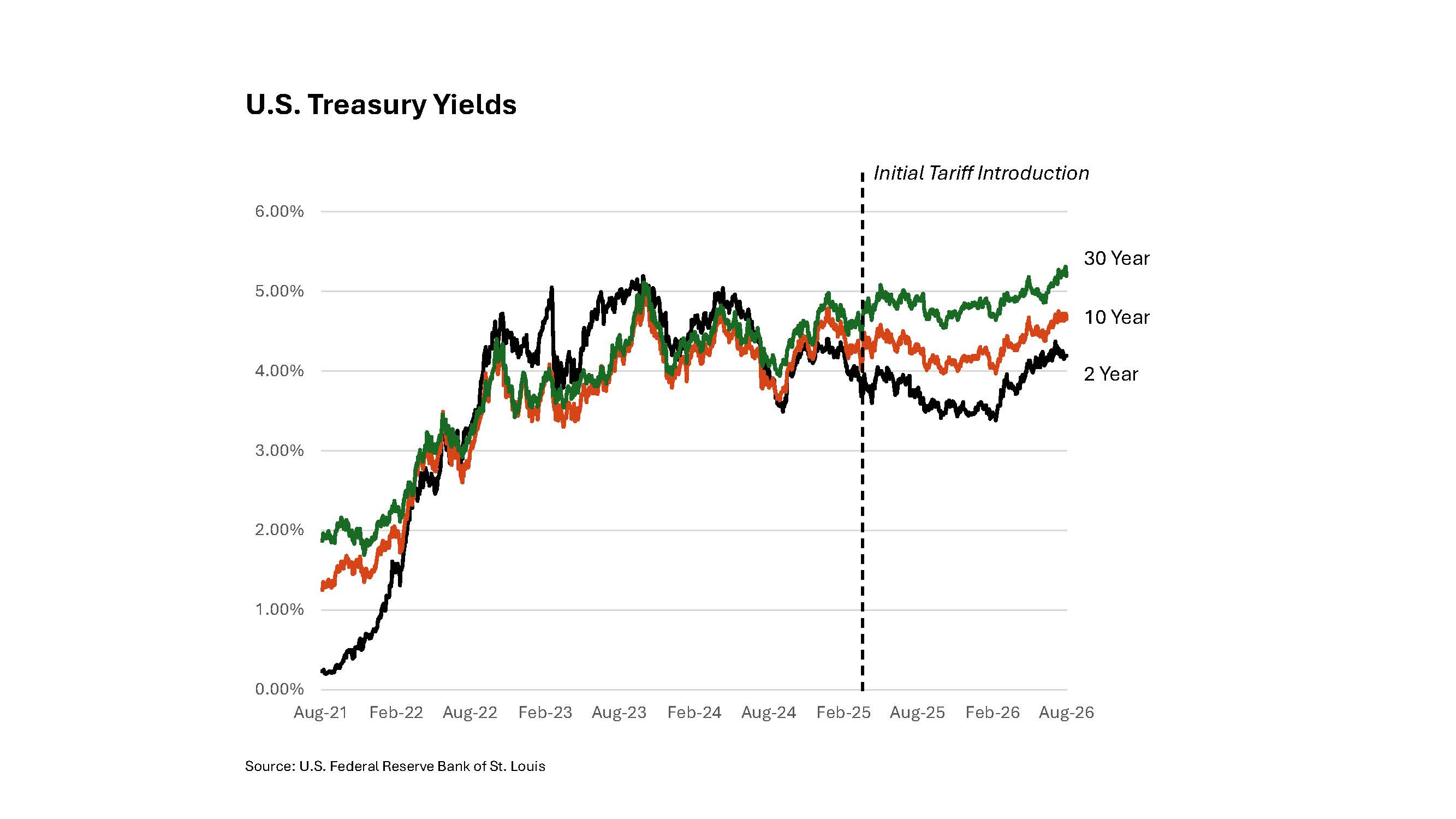
Current U.S. Treasury Landscape
Bond holders today are demanding more term premium to hold longer-term U.S. debt, as can be seen in the chart above following the onset of import tariffs in April 2025.
Yields came down for a period in late 2025 due to cooling inflation, and investors were generally sanguine for a time. That calm did not last: the realization that federal revenue was going to remain well under federal expenditures, in part due to tax cuts that went into effect in 2025, combined with energy disruptions from the Iran War, pushed yields higher.
Today the 30-year U.S. Treasury yields are above 5.00% and have continued upward through much of August 2026. Thus, the term premium continues to rise on longer-duration debt.
Also in mid-August 2026, Treasury Secretary Scott Bessent attempted to arrest the rise in long-term yields by swapping out longer-dated Treasuries, buying them off the market using shorter-term Treasuries. The action is limited in scope, and while it first appeared to soothe investors, that calm receded within days.
Japanese Debt Today
It is important to include Japan in any review of U.S. yields, since it is the largest single holder of U.S. Treasuries. Japan holds $1.16 trillion according to the U.S. Treasury. If the Japanese government makes any changes to its holdings, it can have an impact on U.S. yields. Recently, Japan has been going through its own challenges.
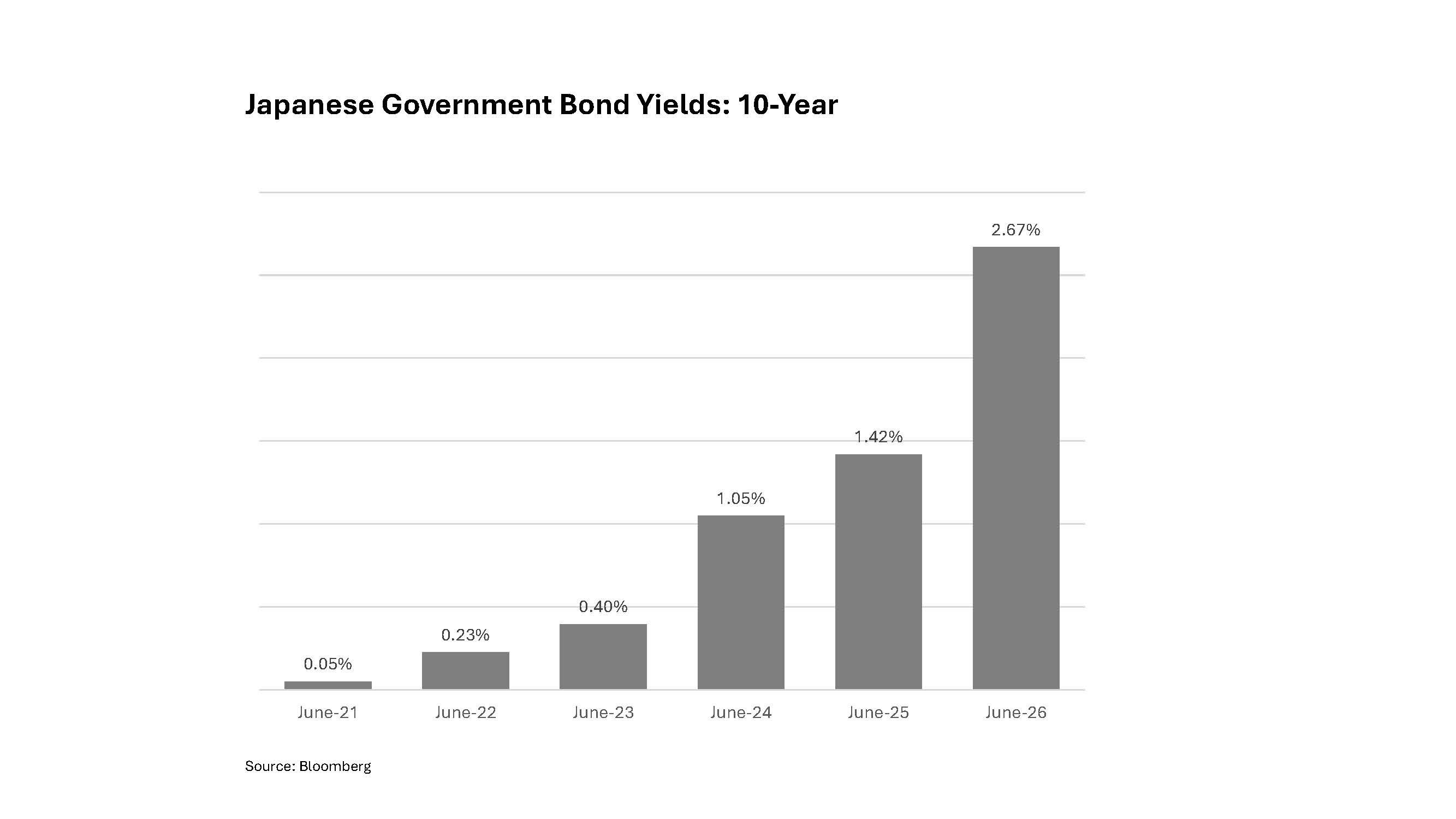
Japanese yields have been on the rise since 2021, climbing faster than U.S. yields. This could spell trouble for the Japanese economy for a variety of demographic reasons.
Japan has an aging and declining population, which together, weaken the Japanese fiscal future. Japan’s Prime Minister Sanae Takaichi has plans to cut national tax revenue while injecting economic stimulus to grow the Japanese economy. Investors saw those plans as increasing risk. As a result, yields moved higher, and it is more likely that the Bank of Japan will raise interest rates.
In late July 2026, Secretary Bessent bought Japanese yen with U.S. currency reserves in a move to prop up the currency's value.
So far it has worked to support the yen’s value, but Japanese Government Bond yields continue increasing despite these efforts.
What does this mean for Commercial Real Estate?
For Landlords
The rise in yields in 2026 lays the foundation for volatility, but it is unlikely to create dramatic near-term impacts on commercial real estate. If yields remain elevated, we can expect to see:
- Higher interest rates on commercial mortgages that get refinanced in the next six to twelve months.
- Upward pressure on cap rates across most asset classes, with higher cap rates on lower-quality assets.
- Stricter underwriting standards, with tenant credit likely to remain a key focus for lenders when refinancing a property’s mortgage.
For Tenants
Some tenants do well in higher interest rate environments. Financial institutions and insurance companies generally fare well when interest rates remain higher. If macro conditions remain volatile, some investment companies can also find safe harbor by trading on the increased volatility.
Companies with conservative balance sheets are also less impacted by higher rate environments. These can be anything from law firms to medium and large family businesses. And if equity is available, A.I. infrastructure capital expenditures are likely to continue, benefiting the “picks and shovels” businesses.
Other tenants may not fare as well. Historically, technology and high growth-oriented companies have done worse in higher rate environments. This may not be as much of an issue for some of the more established businesses (provided they aren’t supplanted by frontier A.I. models), but smaller companies that are raising seed, Series A, or Series B equity typically face greater challenges scaling and raising new capital. The same can be said with clinical stage biotechnology and life science companies that rely on ongoing outside capital to fund research and development.
At high risk will be consumer facing companies, especially if stagflationary trends persist. This can be restaurants, retailers, apparel, packaged goods, travel and leisure, and higher priced food and beverage companies.
Financial sponsors like private equity firms may also find exits few and far between. Some private equity firms have funds that are getting long in the tooth, with limited partners interested in an exit that has not come. According to Pitchbook data, there are about 13,500 private equity-backed companies with U.S. sponsors. Conventionally, general partners want to exit most investments within five years, but now about 30% of all investments have been held for five or more years.
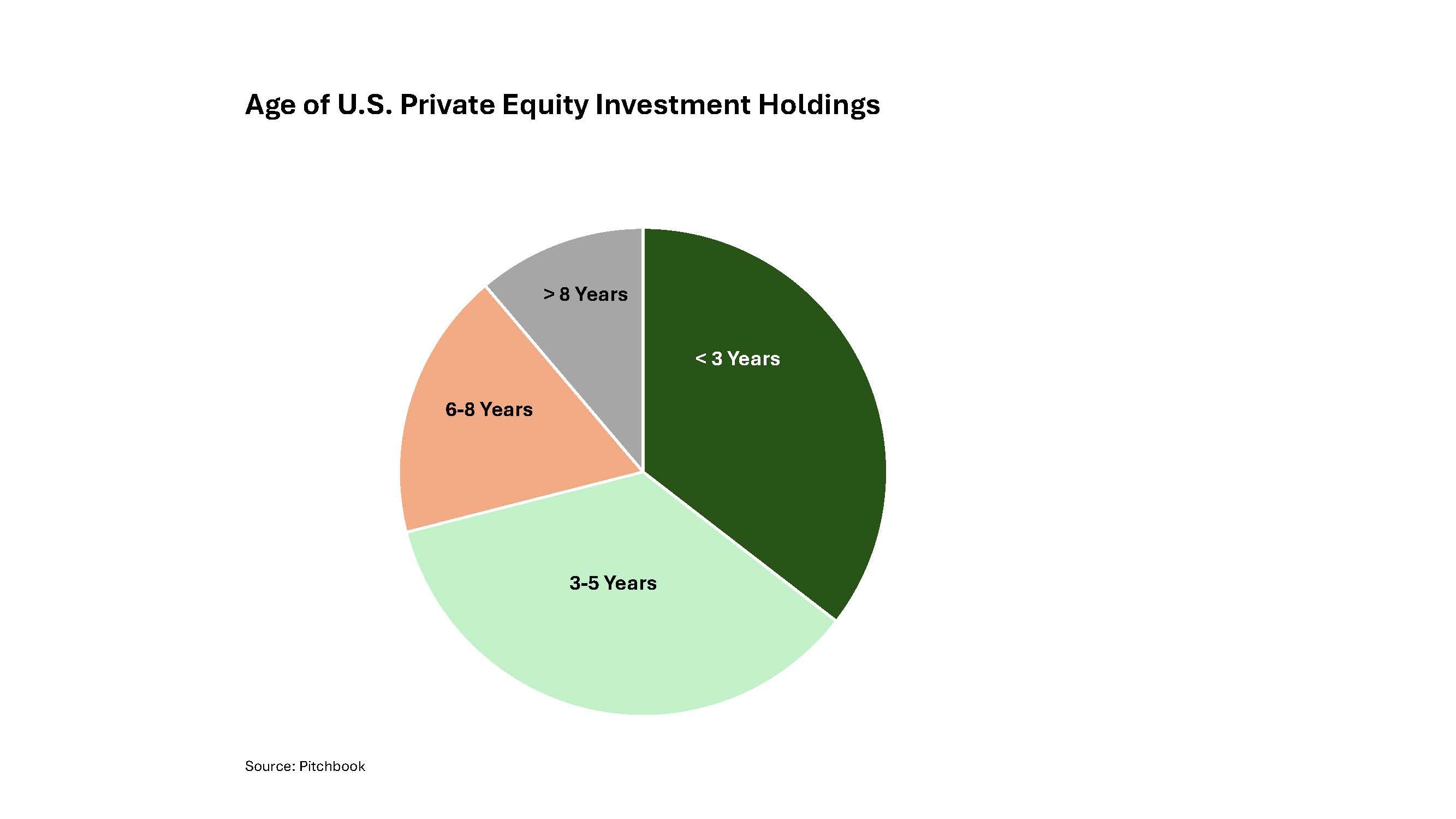
This puts pressure on sponsors to find ways to exit that may include strategies like continuation vehicles, refinancing debt and reinvesting through cross-fund investment, or finding new sources of capital to support an expected eventual exit multiple.
We expect to see companies rely on more creative forms of capital to manage operations and growth across the board. Tenant balance sheets have become more interesting since the pandemic, and the challenges presented by a higher yield environment are likely to push tenants toward more creative financing tools.
TRA is available to advise on specific tenant and portfolio exposures. Contact us at info@tra-llc.com.